
Building wealth is only one part of financial planning. Preserving and transferring that wealth efficiently is equally important.
According to the Income Tax Department, a Hindu Undivided Family (HUF) is recognised as a separate taxable person under the Income Tax Act, 1961 , allowing eligible families to obtain a separate PAN, file independent tax returns, and manage qualifying family assets collectively. Yet many families continue to hold ancestral property, rental income, and family business assets in individual names, overlooking a structure that can support tax efficiency, succession, and long-term family wealth planning. While an HUF is not suitable for every family, it can become a valuable part of a broader estate planning strategy when structured appropriately.
What Is a Hindu Undivided Family?
The Hindu Undivided Family definition refers to a family structure recognised under Hindu law and treated as a separate taxable entity under the Income Tax Act, 1961. The Hindu Undivided Family meaning extends beyond tradition. It enables eligible families to own assets, earn income, file tax returns, obtain an HUF PAN, and operate an HUF bank account independently.
Unlike an individual taxpayer, an HUF has its own legal identity for income tax purposes. This enables eligible families to hold qualifying assets collectively while managing income, taxation, and succession through a single-family structure.
An HUF generally includes:
- A karta who manages the HUF
- Coparceners with rights by birth in ancestral property
- Other HUF members who are entitled to benefits under the family structure
Following the Supreme Court's judgment in Vineeta Sharma v. Rakesh Sharma (2020) , daughters enjoy equal coparcenary rights by birth under the amended Hindu Succession Act, placing them on par with sons in matters relating to ancestral property.
Why Should You Create an HUF?
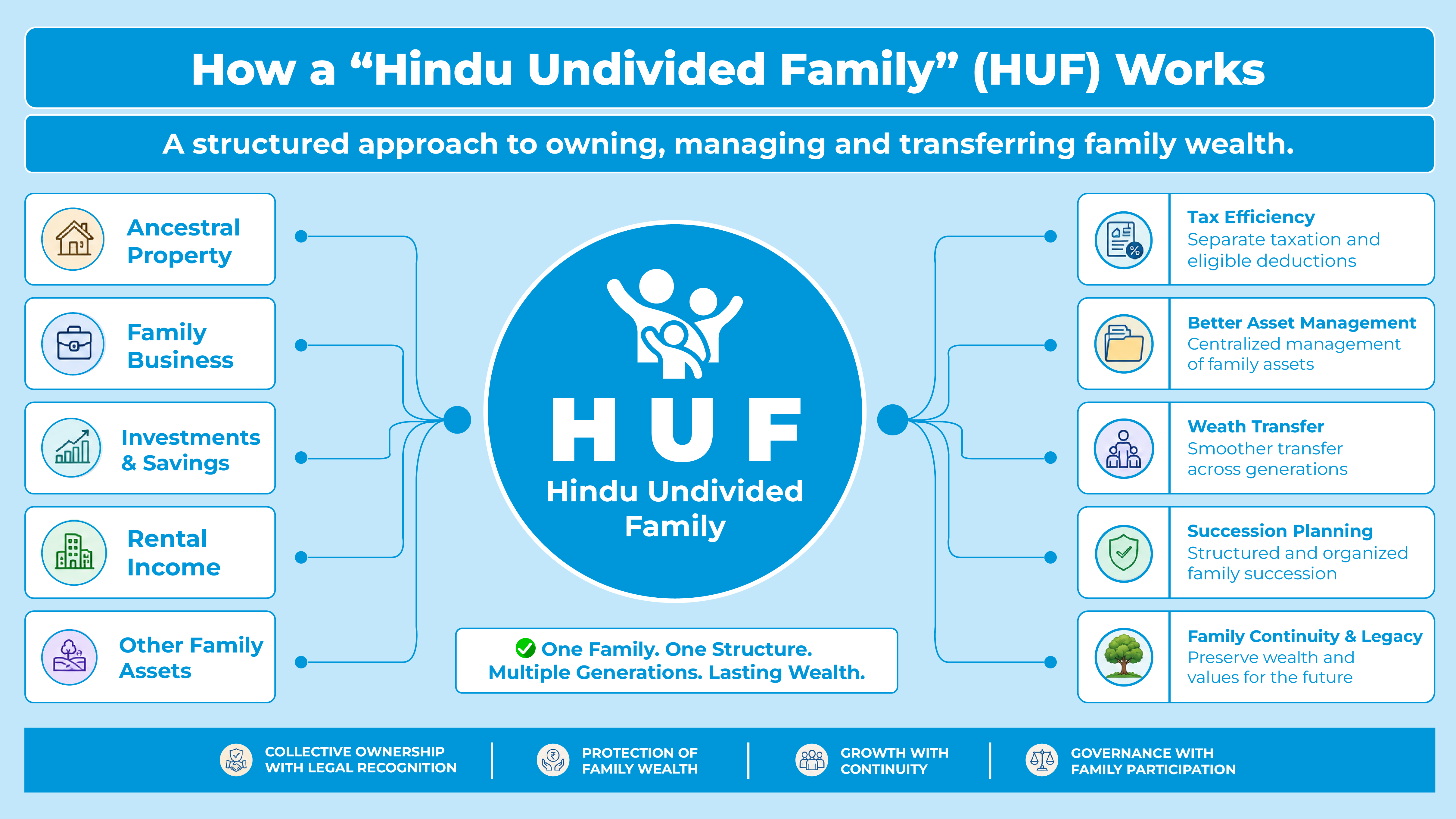
An HUF becomes valuable when a family has shared assets or long-term wealth objectives.
Key advantages include:
- Separate taxation through HUF income tax assessment
- Centralised management of HUF property and investments
- Better succession planning for family businesses
- Structured wealth transfer across generations
- Continuity of ownership without frequent fragmentation
Many traditional family businesses continue operating as an HUF business because ownership remains within the family while management is handled by the karta.
While tax efficiency is often the primary reason families consider an HUF, its long-term value lies in creating continuity of ownership, supporting smoother succession, and preserving family wealth across generations.
How to Create an HUF in 5 Practical Steps
Although an HUF exists by law in many Hindu families, it becomes financially operational only after completing a few formalities.
Setting up an HUF generally involves the following practical steps:
- Preparing an HUF deed
- Applying for an HUF PAN
- Opening an HUF bank account
- Transferring eligible ancestral property or family assets
- Maintaining separate books for HUF assessment and taxation
There is no separate HUF registration authority in India. The PAN and supporting documents generally establish the HUF for tax purposes.
Understanding HUF Tax Benefits
While an HUF offers several tax advantages, these benefits should be viewed as one part of a broader financial strategy rather than the sole reason for creating the structure.
Some important HUF tax benefits include:
- Separate basic income tax exemption limit
- Eligibility for deductions under applicable provisions such as Section 80C
- Independent taxation of qualifying rental, business, or investment income
- Better management of income generated from ancestral property
However, tax planning should never be the only objective. Income clubbing provisions may apply when self-acquired assets are transferred without adequate consideration. Professional advice is essential before restructuring assets.
Who Should Consider Creating an HUF?
An HUF is generally suitable for:
- Families with substantial ancestral property
- Owners of family managed businesses
- Professionals planning estate planning and long-term wealth transfer
- Families looking to consolidate jointly owned assets
- Individuals interested in organised family wealth planning
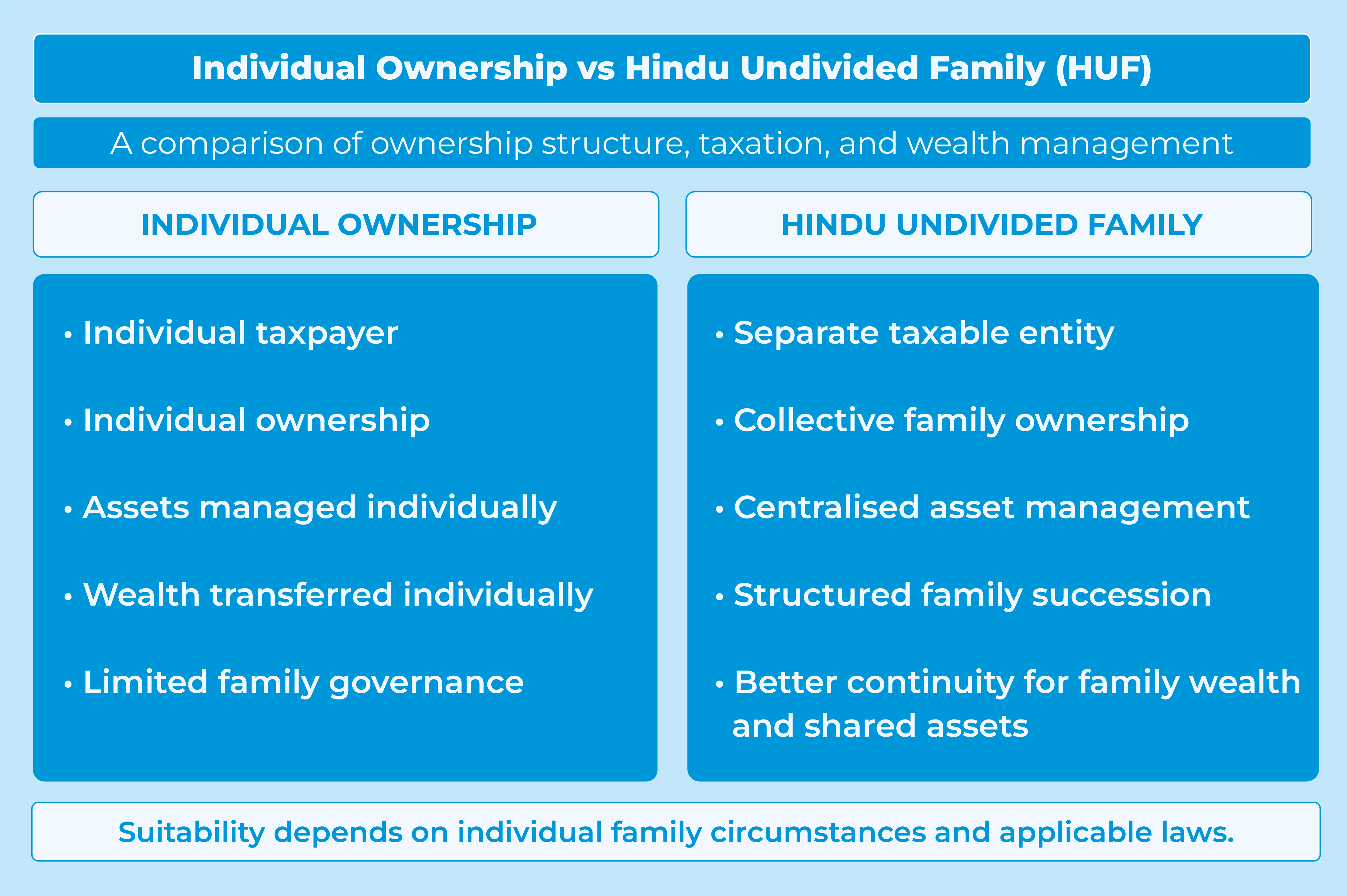
It may be less suitable where assets are limited, family members prefer complete financial independence, or disputes over ownership are likely.
Limitations You Should Know
Like every legal structure, an HUF has practical limitations.
- All coparceners have ownership rights.
- Partition can divide family assets.
- Decisions may become complex as families grow.
- Once assets become HUF property, reversing ownership is not always straightforward.
- Changes in family circumstances or disagreements among coparceners may make long-term management more complex.
Therefore, an HUF should support broader financial objectives rather than exist only for tax savings.
Final Thoughts
A Hindu Undivided Family is not simply a tax planning tool. For the right family, it can become a structured framework for owning assets, managing family wealth, and ensuring smoother succession across generations. When combined with other estate planning instruments such as a Will and a Private Family Trust, an HUF can support a more organised and resilient wealth transfer strategy.
Before creating an HUF, evaluate whether it aligns with your family's assets, financial objectives, and long-term succession goals. Seeking professional guidance can help ensure the structure delivers lasting value while remaining compliant with applicable laws.

If you're considering an HUF as part of your estate planning strategy, the experts at Harmoney FinServ can help you evaluate whether it aligns with your family's financial goals and guide you through the process with confidence.
FAQs
What is a Hindu Undivided Family (HUF)?
An HUF is a separate legal and taxable entity recognised under Indian law that allows eligible Hindu families to own assets and file taxes independently.
Who can become a member of an HUF?
Lineal descendants of a common ancestor, along with specified family members, form an HUF. Coparceners acquire rights by birth.
Is HUF registration mandatory?
No. There is no separate registration process. An HUF deed, PAN, and bank account are generally sufficient for tax purposes.
Can an HUF own property?
Yes. An HUF can own ancestral property, investments, and assets acquired using HUF funds.
What are the tax benefits of an HUF?
Separate taxation, eligible deductions, and independent assessment can improve overall tax efficiency when structured correctly.
Is an HUF suitable for salaried professionals?
It depends. Salaried individuals with ancestral assets or long-term family wealth planning objectives may benefit more than those with only employment income.